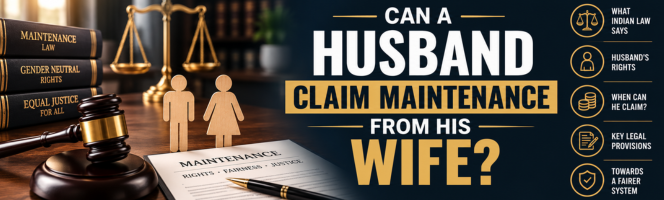
Can a Husband Claim Maintenance from His Wife?

Maintenance is often understood to refer to financial assistance given by a spouse to a wife after the dissolution of marriage or in the course of marital conflicts. But, the Indian law also has provisions for husband to claim maintenance from wife. Such order is not common but cases have been consistently decided that maintenance is not gender specific but is based on financial dependency and earning capacity and the individual facts of each case.
Where a husband is unable to look after himself, because he is ill, disabled, unemployed or for some other valid reason, he may have a legal claim for maintenance under specific provisions of law. Knowing the laws that are in effect can assist spouses in safeguarding their rights and in making sure that everything is conducted fairly in a marriage case.
Is it legal for a Husband to claim Maintenance from wife in India?
Yes. In certain circumstances, a husband can file for husband maintenance in India. Section 125 of the Code of Criminal Procedure mainly provides for the right to maintenance to a wife, children and parents, but the Hindu Marriage Act, 1955, specifically allows either spouse to apply for maintenance when there is a dearth in his/her independent earning capacity.
But the maintenance is not always awarded. When determining whether maintenance should be awarded, courts take a careful look at the financial position, income, earning capacity, health, assets, liabilities, and overall financial situation of both spouses.
Maintenance under the Hindu Marriage Act
The main section that regulates maintenance under Hindu Marriage Act is Section 24 of the Hindu Marriage Act, 1955. It enables either party to apply for interim maintenance and litigation costs on the going of the matrimonial proceedings.
The husband seeking maintenance must prove that the petitioner did not have independent income to support himself or the costs of the maintenance proceedings. The financial ability of both spouses will then be compared to the court to decide if maintenance will be paid.
Interim Maintenance for Husband
Interim maintenance is allowed by the law in the case of husband who is involved in court proceedings before the court, like divorce, judicial separation, restitution of conjugal rights or annulment of a marriage.
It is usually the husband's responsibility to prove that:
- He is not self-employed to make a decent living.
- He can't afford to support himself.
- He has a sufficient financial means to support his wife.
- The claim is truthful and has supporting evidence.
The court reviews the salary slips, bank statements, income tax returns, business income, liabilities, medical records etc. before issuing an order.
Can a Working Husband Make a Maintenance Claim from His Wife?
Yes. The fact that a man is working does not preclude him from receiving an award for permanent alimony for the husband or for interim alimony. The determining factor is whether he can afford to earn this salary and cover his reasonable costs.
Where the wife has a substantially greater income than the husband and he is unable to earn an income due to disability, illness, unemployment or special financial circumstances, the court may make a maintenance order after taking all relevant circumstances into account.
Eligibility is not determined by employment and each case is decided based upon the facts.
Spouse Maintenance Law in India
The concept of spouse maintenance under Indian law is to provide financial support to a spouse who is unable to maintain himself. Courts consider actual financial dependency, not presumed based on gender.
Maintenance is not a penalty to be paid to either spouse. On the contrary, it allows a financially weaker spouse to live in dignity till the resolution of matrimonial disputes or after the marriage.
Prior to any maintenance order being passed the court will consider the interests of both parties.
Why You Should Consult a Maintenance Lawyer
In a maintenance proceeding, a detailed affidavit of financial conditions, documentary evidence and legal arguments are required. A lawyer will be able to evaluate, prepare the necessary paperwork, gather supporting documents, and advocate for you in court.
From filing a family court maintenance action to defending against one, professional legal advice will assist you to prevent procedural error and to ensure that the rights are properly protected.
In divorce, judicial separation and permanent alimony cases, it is important to allow an experienced divorce maintenance attorney to help present your case.
Conclusion
Maintenance claims by husbands are not as prevalent, but in India, under certain conditions, the husband may be awarded financial support. When determining monetary considerations, the court takes into account the financial needs of the parties, their earning capacity, the health of each party, assets and liabilities, the comparative financial circumstances of both parties, and other factors.
Each maintenance dispute is different, and the result will be based on the evidence presented to the court. An experienced maintenance case attorney can provide you with the legal advice you require when it comes to the legal rights you may have, your case preparation, as well as the means to steer matrimonial process in the correct direction.
Frequently Asked Questions
Q1. In India, can a husband claim maintenance from wife?
Yes. An income deficient husband can apply for interim maintenance from wife pursuant to Section 24 of the Hindu Marriage Act, 1955 depending on the circumstances of the case.
Q2. Under which law a husband can claim maintenance?
If there is a husband, he can claim maintenance according to Section 24 of the Hindu Marriage Act, 1955 (HMA). The court takes into account the financial situation of both parties, the income, earning capacity and the circumstances of both parties.
Q4. Can a man who is employed get maintenance from his wife?
Yes. Even if the husband is gainfully employed, he may request maintenance if his income is not enough to provide for the reasonable needs of the wife, while wife receives a higher income. The court takes into account all of the financial factors.
Q5. What is the maintenance determined by?
This will take into account the income, assets, and liabilities, health, age, number of dependents, standard of living, and length of marriage.
Q6. So why should I hire a maintenance lawyer?
A maintenance lawyer will be able to determine your eligibility, compile legal paperwork, collect evidence, advocate for you in front of the family court, and ensure that your legal rights are protected during the process.
Latest Blog

Learn how professional legal drafting can protect your rights, prevent disputes, reduce legal risks, and strengthen your position before a case reaches court.
Understand when a husband can seek maintenance from his wife under Indian law. Learn about interim maintenance, financial dependency, court factors, and legal remedies.

Know the immediate steps to report online fraud, recover your money, file a cyber crime complaint, and seek legal assistance in India.

Social Media Defamation in India: What Indian Law Says explains how false statements, fake reviews, edited images, and misleading social media posts can damage the reputation of individuals and businesses.

This blog explains the importance of professionally drafted business contracts, including Vendor Contract Agreements, Client Service Agreements, and other commercial legal documents.
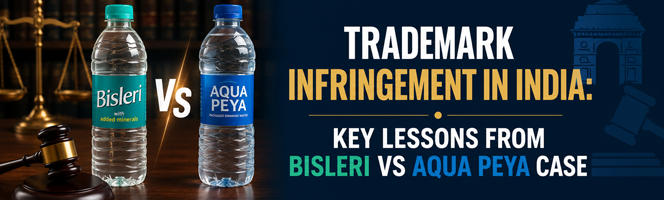
The Bisleri vs Aqua Peya trademark dispute highlights the importance of protecting intellectual property rights and maintaining a unique brand identity in India.

Explore the legal implications of AI-generated brand names, trademarks, branding risks, and the steps businesses should take to secure trademark protection.

WhatsApp chats have become an important form of electronic evidence in Indian legal proceedings, including divorce, family disputes, civil matters, and criminal cases.

This blog explains the importance of Intellectual Property (IP) protection for Instagram businesses, creators, influencers, and startups. It highlights how trademark registration helps protect brand identity, logos, content, and business reputation.